The Lawn That Loses Money Every Week: How to Find Unprofitable Lawn Care Customers
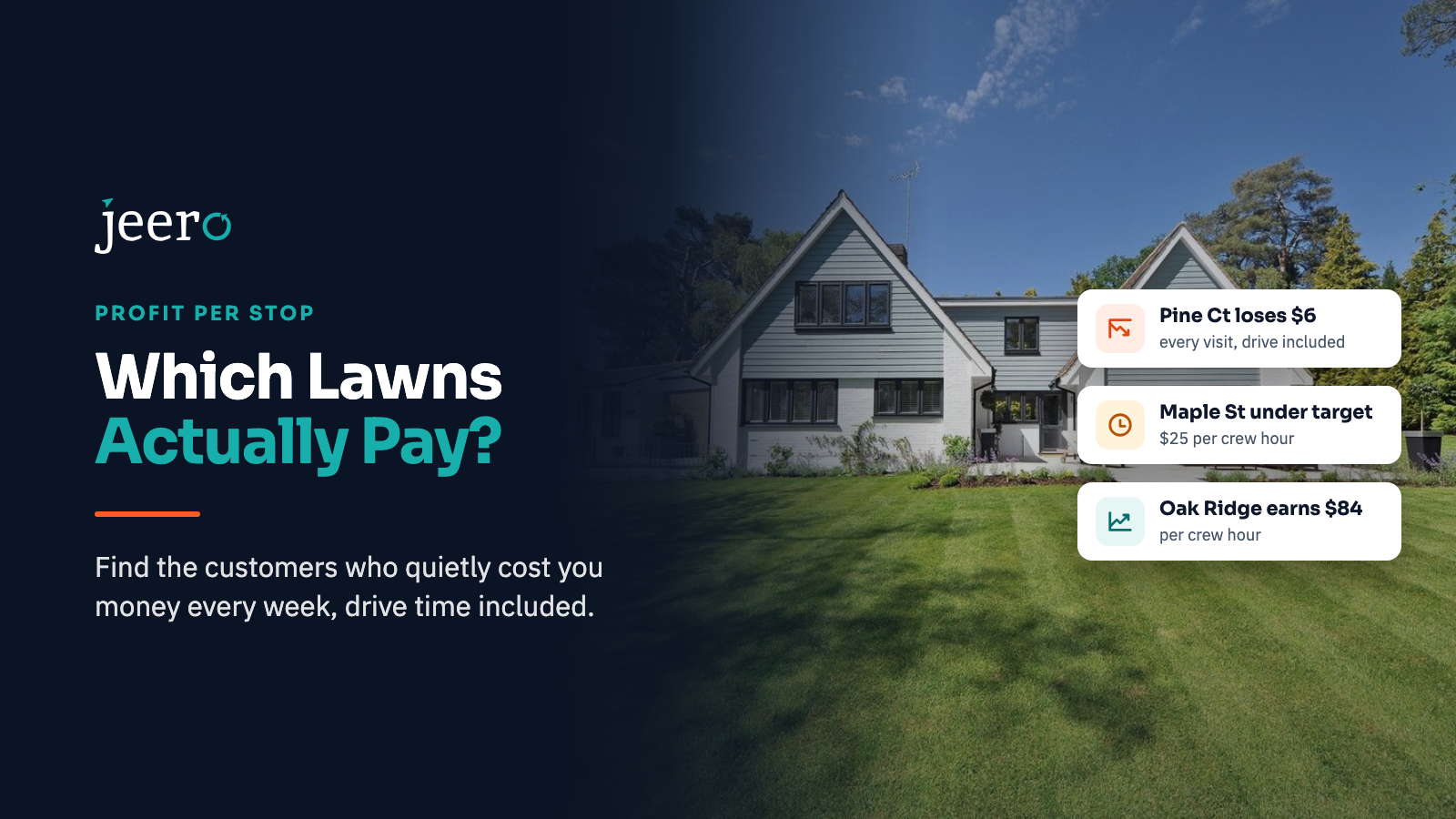
There are two lawns on Maple Street. Same size, same weekly mow, same $55 a visit. On the invoice they look identical. One of them pays your crew well. The other one has been losing you money every Tuesday since April, and nothing in your books will ever tell you which.
Most lawn care owners price by the lawn. Size, slope, obstacles, a number that feels right for the neighborhood. What actually decides whether a stop makes money is time: how long the crew is on the property, how long it takes to get there, and how many people are standing on that grass while the clock runs. Price is fixed when you quote. Time keeps changing all season.
This guide shows how to work out what each stop really earns per hour, how to set the number every stop has to clear, and what to do with the accounts that fall short.
Why a losing lawn hides so well
An unprofitable account rarely looks like one. It is usually one of these:
- The far one. A customer you picked up because a neighbor referred them, fifteen minutes past the edge of your route. The mow takes thirty minutes. The detour takes thirty more, round trip, every week.
- The one that grew. You quoted it in March when the beds were bare. By July the hedges need trimming every visit and the crew spends forty-five minutes on a thirty-minute lawn.
- The gate. The side gate is locked one week in three. The crew knocks, calls, waits, and either leaves or loses ten minutes getting in.
- The two-person lawn. A property that only needs one person, but it sits in the middle of a route run by a two-person crew. Both of them are on the clock.
None of these show up on an invoice. Revenue per stop looks healthy. What you are missing is the other side of the ledger, and it is made of minutes.
The number that matters: earned per hour of crew time
Profit per visit is useful, but the number most owners price by is what an hour of crew time brings in. Work it out like this:
- Take what the visit earned.
- Subtract materials, fuel and any expense tied to that visit.
- Divide by crew hours: minutes on site plus minutes driving to the stop, times the number of people on the crew.
Here are the two Maple Street lawns with a two-person crew:
Lawn A | Lawn B | |
|---|---|---|
Price per visit | $55 | $55 |
Drive to the stop | 5 min | 18 min |
Time on site | 25 min | 40 min |
Crew hours (2 people) | 1.0 h | 1.9 h |
Fuel and mileage | $2 | $6 |
Earned per crew hour | $53 | $25 |
Same street, same price, half the money per hour. If your crew costs you $22 an hour per person in wages and payroll, Lawn B barely covers labor before you have paid for the mower, the truck, insurance or yourself.
Set the minimum every stop has to clear
Breaking even is not the bar. You need a minimum earned per hour: the number an hour of crew time has to bring in for the business to work once equipment, insurance, the truck payment and your own salary are paid.
A simple way to get there:
- Add up a normal month of overhead: equipment payments and repairs, insurance, truck costs, phone, software, your own draw.
- Divide by the crew hours you actually bill in that month, drive included.
- Add average labor cost per crew hour.
- Add the margin you want to keep.
For most small lawn care and landscaping crews that lands somewhere around $50 to $90 per operator hour, depending on the market. If you have never done the exercise, start at $50 and adjust. The exact number matters less than having one, because it turns a vague feeling about a customer into a yes or no.
How to find your losing stops by hand
You can do this with a notebook and one normal week:
- For each stop, have the crew lead write down the time they arrived, the time they left, and the time they left the previous stop.
- Note how many people worked the property.
- Put it in a spreadsheet with the price, and calculate earned per crew hour with the formula above.
- Sort lowest first. Anything under your minimum is a stop to look at.
It works, and it will surprise you. It also has three problems. Crews forget to write times down by Wednesday. One week is a snapshot: the gate was open, the hedge had just been trimmed, it was a short week. And by the time you have enough weeks to trust the average, the season is half over and you have mowed the losing lawn another twenty times.
What it looks like when the numbers keep themselves
The reason most owners never find their losing stops is not the math. It is collecting the minutes. So we built Jeero's Profitability page to use the minutes your crews already record.
When a crew taps On my way, Start and Finish in the app, that is the drive, the time on site and the crew size. Add each crew member's labor rate, the cost on any parts, mileage at your company rate and expenses logged against the job, and every visit gets a real cost the moment it is finished. Nobody fills anything in.

The page then does the sorting for you:
- Worst first. Stops that lose money at the top, then stops under your minimum per hour, then everything else from lowest to highest.
- One row per account. A weekly mow with eight visits in the period is one line, averaged, so one bad week doesn't mislead you and one good week doesn't hide a problem.
- Your minimum, right on the page. Type the number, save, and every stop below it turns red. Nudge it and watch which accounts cross the line.
- Every visit laid out like a receipt. Open a stop and each visit shows what it earned on one side and what it cost on the other: each crew member's minutes on site and driving, mileage, parts, expenses. That is where you find the Tuesday the gate was locked or the month the hedge doubled the visit.
Pick a period, last 30 days or the whole season so far, filter to one crew if you run several, and the list you would have spent a season building in a spreadsheet is there on the first screen. The same page is in the mobile management app.
What to do with a stop that comes up short
Finding the losing lawn is the easy part. Here is what owners actually do next, roughly in order of how often it works.
Reprice it
The most common fix and usually the right one. You have the numbers, so the conversation is short: the property takes longer than when you quoted it, and the price has to follow. Many owners raise prices on their underperforming accounts first, before any general increase, because those are the customers where losing them costs you least. Most customers stay. The ones who leave were paying you less than your time was worth.
Fix the route, not the price
If a stop is expensive only because of the drive, look at where it sits in the day. Moving it next to its nearest neighbor, or to the crew whose route already passes by, can turn an eighteen-minute detour into five. Check it after rebuilding the route before you raise anything.
Change what the visit includes
When the time on site crept up because the job grew, price the growth separately. Hedge trimming every visit becomes a monthly add-on. Leaf cleanup becomes its own line in the fall. The mow stays at the price the customer expects.
Change who goes
A one-person lawn on a two-person route doubles its crew cost. If you run more than one crew, move it to a smaller one or a solo operator's day.
Let it go
Sometimes a stop is far, slow and priced where the customer won't move. Letting it go frees a slot in a denser part of the route for a customer who pays your minimum. Do it at the end of a season, with notice, and with a referral to someone closer if you can.
Frequently asked questions
What is a good profit per hour for a lawn care business?
There is no single number, because overhead and wages vary by market. Many small crews need somewhere between $50 and $90 per operator hour, drive included, to cover labor, equipment, insurance and a real margin. Work out your own minimum from your costs and use it as the bar every stop has to clear.
Should I include drive time when pricing lawn care?
Yes. Drive time is paid time. A stop fifteen minutes out of the way costs your crew half an hour round trip every visit, and over a season that is often more time than the mow itself. Either price it in, or schedule the stop where the drive is short.
How do I tell a customer their price is going up?
Keep it short and specific: the property takes longer than it did when you quoted it, here is the new price, here is when it starts. Give a few weeks of notice, ideally before the season or at a natural break. Customers accept an increase tied to the work far more readily than a general one.
What is job costing for lawn care?
Job costing means tracking what each job actually cost you, labor, drive, materials and expenses, and comparing it with what you charged. For recurring lawn care the useful version is per account, averaged across visits, so you can see which customers pay for your time and which ones don't.
Find your Lawn B this week
Every route has one. Usually more than one. You can find them with a notebook and a month of discipline, or you can let the taps your crews already make do the work.
If you want to see it with real numbers, open the demo and go to Profitability, or start a free trial and look at your own stops after the first week of visits. Profitability is included on the Business plans; see pricing.