"You Never Came This Week": How to Prove Every Lawn Care Visit and Stop Payment Disputes
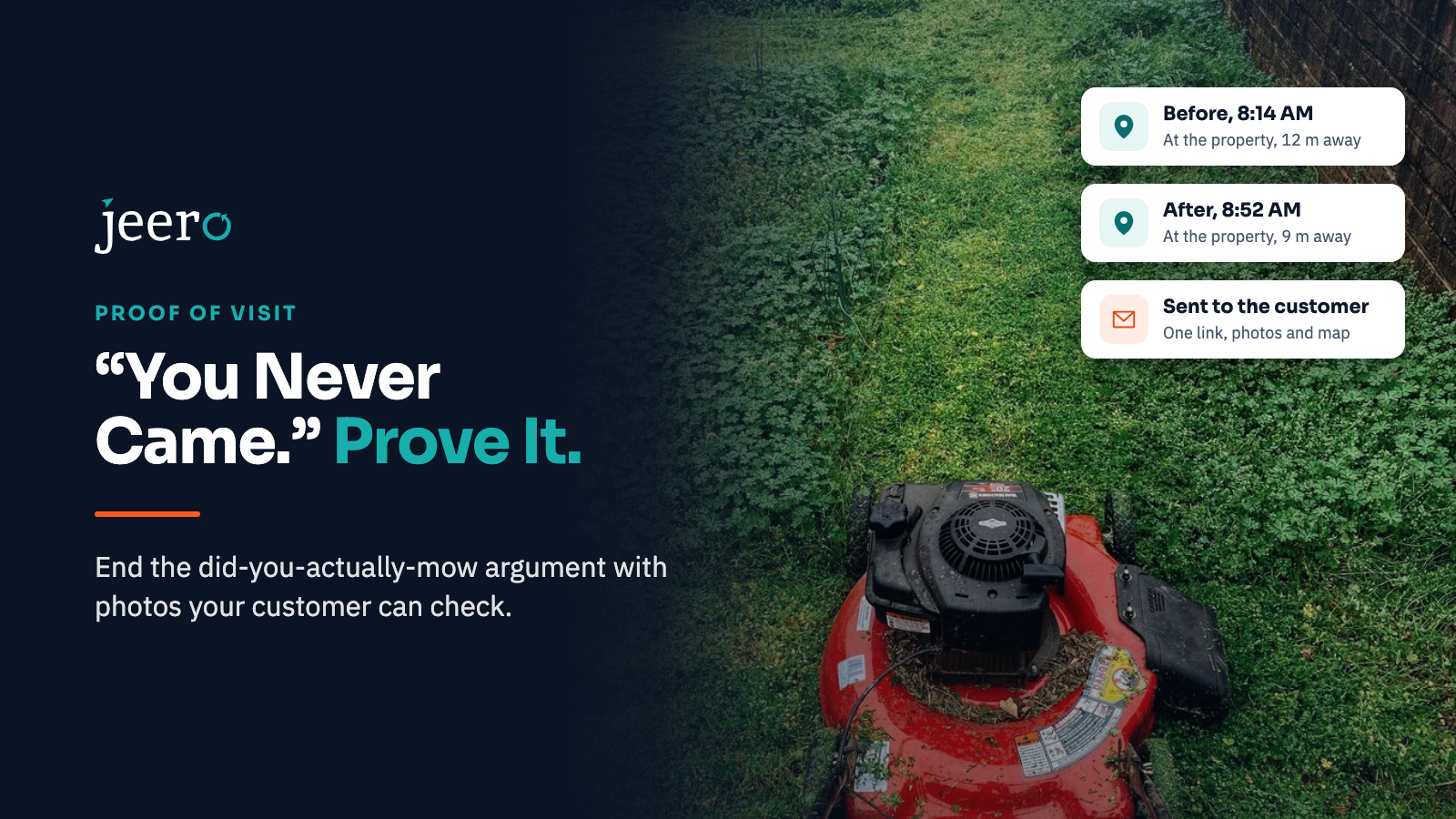
It is 8:40 on a Thursday night and your phone lights up. "Hi, just checking, did you guys skip us this week? The lawn looks the same." Your crew lead swears they were there Tuesday morning. You believe him. The customer believes their lawn. The invoice for that visit is sitting unpaid, and the only thing standing between you and a refund request is your word against theirs.
Every lawn care and landscaping business gets this message. Usually it is not a scam. It is a customer who was at work when the crew came, a lawn that grew an inch back in four days of June heat, or a neighbor's yard that looks a lot like theirs from the kitchen window. The customer is honestly unsure. What decides how it ends is whether you can show them, in a minute, something they can check for themselves.
This guide covers why these disputes happen, what actually counts as proof, and how to send it so the conversation ends with a thank-you instead of a credit.
Why customers think you skipped them
Knowing the usual causes helps you answer calmly instead of defensively:
- Fast growth. In peak season a lawn cut on Tuesday can look untouched by Saturday, especially after rain. Customers judge by what they see when they get home, not by what the lawn looked like at 9 a.m.
- Nobody was home. Weekday service means most customers never see the crew. No truck in the driveway, no noise, no memory of a visit.
- The day moved. A rain delay pushed Tuesday to Wednesday, the customer looked on Tuesday evening, and the message about the new date got lost.
- It is really a quality complaint. A missed strip along the fence or clippings left on the drive becomes "did you even come?" because that is easier to say.
- Someone else was on the property. A property manager, a tenant, or a spouse who didn't pass the message along.
In almost every case the fix is the same: show the visit, politely, with details that are hard to argue with.
What these disputes actually cost
A single disputed mow is $50. The real cost is what happens around it:
- You credit the visit to keep the peace, and the customer learns that asking works.
- You spend twenty minutes on the phone and another ten asking the crew lead to remember a Tuesday from two weeks ago.
- The customer pays by card and files a dispute with their bank, and now you need evidence in a format a bank will accept.
- Your crew hears that the office took the customer's side, and the next time they cut corners on the photos.
Businesses that rarely lose these arguments are not the ones with the nicest customers. They are the ones with a record for every visit.
What counts as proof, and what doesn't
Not all evidence is equal. Here is roughly how a skeptical customer, or a bank handling a card dispute, will see it:
Evidence | How convincing | Why |
|---|---|---|
Your crew says they were there | Weak | It is your word against theirs. |
A photo of a mowed lawn | Weak | It could be any day, and from the street many lawns look alike. |
A photo with the date and time | Better | Proves when, not where. |
Before and after photos, timed and located at the property | Strong | Shows the work, the day, and the address together. |
All of the above, on a page the customer opens themselves | Strongest | They check it instead of taking your word for it. |
The last row matters more than it looks. A screenshot you send can be doubted. A link the customer opens, showing their own address, the time each photo was taken and where on a map, is something they verify on their own. People trust what they checked.
How to build a proof habit by hand
You can get most of the way with phones and discipline:
- Same angles every visit. One photo from the street and one from the back corner, before and after. Consistent framing makes before and after obvious.
- Location and time on. Make sure every crew phone saves location with photos.
- A folder per customer. Upload at the end of each day so you can find a visit weeks later.
- Reply with the photos, not an argument. When the message comes in, send the pair with the date and a friendly note.
The weak points show up fast. Crews forget the before photo because they are already mowing. Camera rolls fill with a hundred identical lawns. Photos sent through many messaging apps lose their original time and location details on the way, so what the customer receives is a picture with no proof attached. And finding the right Tuesday three weeks later, on a Thursday night, is exactly the job nobody wants.
What it looks like when every visit carries its own proof
We built proof into the visit itself in Jeero, so there is nothing to remember and nothing to dig for.
In the crew app, the before photo is part of starting the job and the after photo is part of finishing it. You can require both, so a job can't be marked done without them. Each photo is stamped with the moment it was taken and where the crew was standing. Photo geofencing is on by default: Jeero checks that location against the property, 100 meters around it unless you change the radius. Photos taken on site get a map pin, and a photo taken somewhere else is flagged for you to review, without ever blocking the crew.
When a customer asks, you don't send screenshots. Once a job is completed and has at least one photo, you create a proof-of-visit link from the job page or from the mobile management app, copy it into a text, or email it straight to the customer's address on file. What they open is a clean page with your company name on top that shows:
- The visit. The service address and when it was completed.
- A map of where the photos were taken, with their property marked, so they see the pins sitting on their own lot.
- Every before and after photo, each with the time it was taken. A photo that passed the location check says taken at your property, with how many meters from it.
- The invoice for that visit, its total and whether it is paid, with a read-only copy one tap away, once it has been issued.

The page only claims what was actually checked. A photo that was never checked against the property shows its pin and time with no claim at all, and a photo with no location shows neither. That restraint is the point: a customer who notices the page is careful about what it says trusts the parts that do say taken at your property.
Nothing internal reaches the page: no crew names, no job notes, no costs. The link is private to that customer, expires on its own after 90 days, and you can revoke it or replace it with a new one at any time. Only owners and managers can create one, so what customers see is always your call.
How to send proof without sounding defensive
Proof ends an argument. Tone decides whether you keep the customer. A few habits that work:
- Lead with thanks, not a correction. Something like: thanks for checking in, here are the photos from Tuesday's visit, taken at 9:12 and 9:48. Let us know if anything looks missed and we'll swing back.
- Offer the fix even when you're right. If there is a real miss in the after photo, a strip by the fence, own it and come back. It costs ten minutes and buys a season.
- Send it before they ask. New customers, owners who travel, rental properties and property managers love a link after each visit. A customer who has seen proof twice never sends the Thursday night text.
- Keep it with the invoice. When proof and the bill arrive together, "did you come?" is answered before it is asked.
Frequently asked questions
What is proof of service in lawn care?
Proof of service is a record showing a visit happened: when the crew was there, at which property, and what the lawn looked like before and after. The strongest version combines timed, located before and after photos in one place the customer can open.
What should I do when a customer says the lawn wasn't mowed?
Stay friendly, send the before and after photos from that visit with their time and location, and offer to come back if anything was missed. Most disputes end there, because the customer genuinely wasn't sure.
Can a customer dispute a lawn care charge with their bank?
Yes. Card payments can be disputed, and the business is usually asked to show the service was delivered. Dated, located photos of the visit alongside the invoice are the kind of evidence that helps.
Should I send customers photos after every visit?
For most weekly accounts, sending on request is enough. For new customers, owners who are rarely home, rentals and commercial or property-managed accounts, sending after each visit prevents disputes before they start.
Do photos sent by text keep their date and location?
Often not. Many messaging apps remove the original time and location information when a photo is sent, so the customer gets the picture without the proof. A shared page that shows the capture details keeps them visible.
Answer the Thursday night text in a minute
The next "did you skip us?" message is already on its way. When it lands, the difference between a credit and a thank-you is a link you can send before you've put the phone down.
See how visit photos work in the demo, or start a free trial and turn on required before and after photos for your crews on day one. Compare what each plan includes on the pricing page.